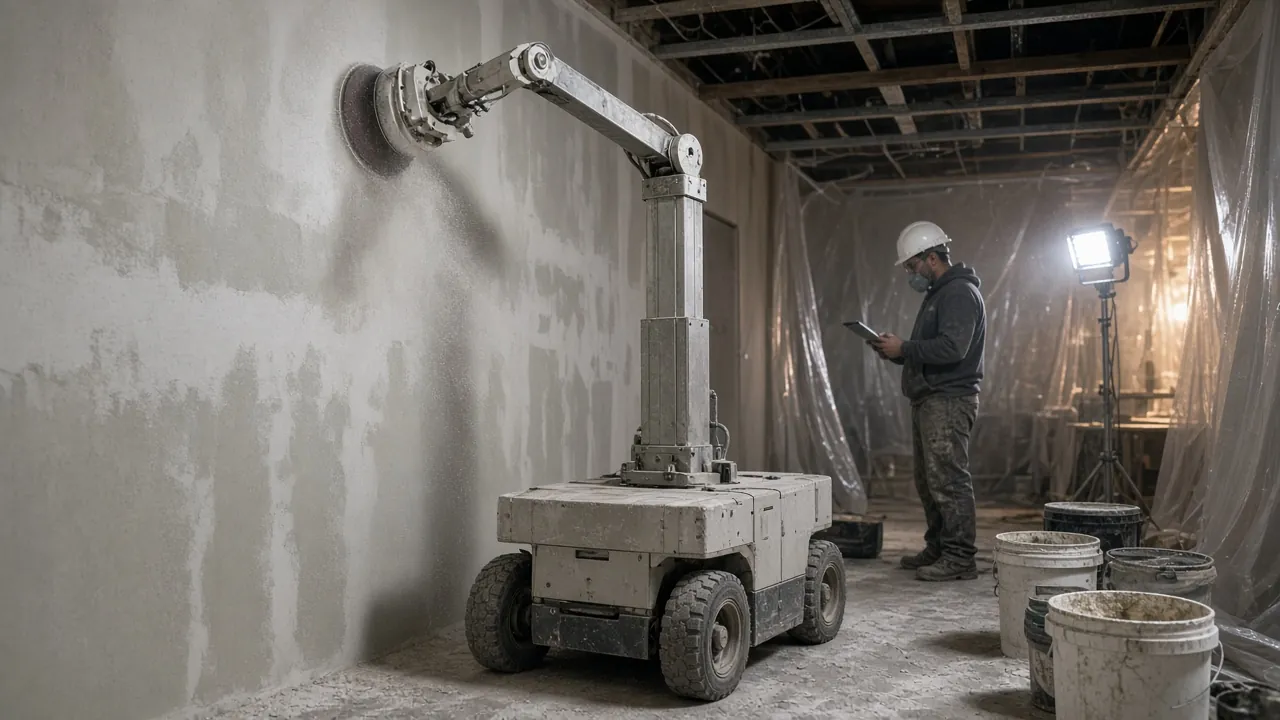
Drywall Robots Leave the Lab: OG-1 and Canvas Take On Mud and Sand
Wall finishing is slow, dusty, overhead work, the kind of job basement and commercial crews struggle to staff. Two robots now aim squarely at it. One claims three times human speed. Here is what the companies say, and what a contractor should ask before believing it.
Anyone who has finished a basement knows the rhythm of drywall: tape, mud, wait, sand, mud again, sand again, prime. It is skilled work, it is hard on shoulders, and it fills a jobsite with fine dust. It is also one of the first interior trades where robots are moving from trade-show demos onto real projects.
Two announcements this fall show where that line now sits. On October 15, 2026, a startup called Origin came out of stealth with $20 million in funding and a wall-finishing robot named OG-1. On November 14, Oshkosh Corporation said JLG's Canvas RO2330 drywall finishing robot had been named a CES Innovation Awards 2027 Honoree.
What OG-1 Claims to Do on Its Own
Origin's press release is direct: OG-1 "autonomously completes wall-finishing workflows without human intervention. It applies compound, sands and primes walls to a professional finish." The company says the machine moves on a three-wheeled platform, has a 360-degree view of its surroundings, works at heights up to 14 feet, and uses "real-time force control to keep consistent pressure against the wall" while sanding.
The software side is called a Construction Action Model. Origin describes three parts: a reasoning system that plans sub-tasks, an action policy that decides where to work and checks the quality of the result, and a controller that turns those decisions into motion. The company says it trains the model on simulation and data from live job sites.
The headline number comes from co-founder and CEO Yogesh Ghaturle: "Today, our robots are already working at three times human speed, delivering human-level quality and generalising across different site conditions." That is a company claim. Forbes, which also reported the 3X figure, framed it the same way: "the company says."
Industry warning: "Three times faster" needs a baseline. Faster than one finisher or a full crew? At which finish level? Including setup and mapping, or only wall time? None of that is in the release. Ask before you budget around it.
What the Humans Still Do
The more useful detail is buried lower in Origin's announcement. The robot "works alongside construction crews, taking on physically demanding tasks and hazardous work at height, while crews handle site mapping and material replenishment." In other words, today's version still depends on people to set up the job and keep it supplied.
Origin says OG-1 has been deployed in commercial spaces, multi-family apartments, data centers, hotels and warehouses, that its first robots reached job sites in New York within 10 months of founding, and that it is targeting 150 robots deployed by the end of 2027. It plans to add taping, drywall installation, drilling and conduit work on the same platform.
JLG's Different Bet: One Operator, Several Machines
JLG, best known for aerial work platforms, is taking a more conservative route. Its product page describes the Canvas RO2330 as having self-drive with auto-steer, battery power for a full day, and AI features including "auto mapping, seam detection, alignment, calibration, force control, and material application." JLG says it reaches up to 23 feet from a 39.4 by 30 inch body.
Earlier coverage of the preview model called it a "worker-controlled system" for Level 4 spray and sand work. Walls & Ceilings reports that Oshkosh designed it "to allow one operator to manage multiple robots." Oshkosh will demonstrate it at CES in Las Vegas, January 6 to 9, 2027.
| Origin OG-1 | JLG Canvas RO2330 | |
|---|---|---|
| Control model | Autonomous finishing, crew supports | Operator-supervised, one person per several robots |
| Stated reach | Up to 14 ft | Up to 23 ft |
| Tasks named | Compound, sanding, priming | Level 4 spray and sand |
| Status | Deployed; pilots in US and Europe | CES 2027 Innovation Honoree |
| Headline claim | 3X human speed (company) | Consistent finish, extends workforce (company) |
Why Robots Picked This Trade First
Origin's own framing is about labor. Its release cites a 2026 survey in which worker shortages delayed projects for 42% of responding U.S. construction firms, and argues that interior work "accounts for more than 65% of the construction timelines" yet is still mostly done by hand.
Wall finishing also suits a machine. The surfaces are mostly flat, the quality target can be measured, and the work repeats across thousands of square feet. Sanding is exactly where force control beats a tired arm at the end of a shift. And the dust problem gives a clear safety argument: OSHA's construction silica standard exists because respirable crystalline silica damages lungs, and JLG's earlier preview materials said its machine captures dust and silica.
The Messy Middle for a Basement Contractor
Will a robot finish your basement next year? Probably not. Both companies are aimed at large commercial projects: data centers, hotels, warehouses, multi-family buildings. Residential basements have short walls, tight stairwells, soffits around ductwork and a lot of small rooms, which is the hardest geometry for any machine to move through. Origin says OG-1 handles "corners, pillars, soffits and edges," but its deployment list is commercial.
- If you run a commercial drywall crew: request a pilot and measure it against your own crew on the same floor. You have the leverage; both firms want reference customers.
- If you do residential remodels: watch, do not buy. Expect smaller machines and rental models before these make sense in a basement.
- If you are a finisher: the jobs named in these releases (mapping, supply, inspection) are the ones that stay human. Those skills are worth learning now.
The Inflection Point
For decades, construction automated the heavy exterior work and left the inside of the building to hands and hand tools. These two machines are a sign that the inside is next, starting with the dustiest, most repetitive trade. The claims are still mostly company claims, and the first fleets are small: Origin is aiming for 150 robots by the end of 2027. But the direction is clear. The question for contractors is no longer whether a robot can sand a wall. It is who on the crew will run, supply and inspect it.
Sources
We checked every fact, figure and quote in this story against the sources below. Quotes are reproduced as published. Images are AI-generated illustrations, not photos of the events described.
- Origin press release: Origin emerges from stealth with $20 million (Oct 15, 2026)
- Forbes: This robot finishes drywall 3X faster than humans (Oct 15, 2026)
- JLG: Canvas RO2330 product page
- Walls & Ceilings: JLG drywall robot earns CES 2027 Innovation honor (Nov 14, 2026)
- Lift and Hoist International: JLG previews the Canvas Robotics drywall robot (Jul 13, 2026)
- OSHA: Respirable crystalline silica in construction

RABTP Newsroom
Every story is researched against primary sources, then reviewed by publisher Sean Hakes before it goes live. We cover threats from the defender's side and never publish exploit details. Read our standards or send a correction.