Xiaomi's Humanoids Worked an 8-Hour Factory Shift. What the Video Shows
Xiaomi posted a time-lapse of two humanoid robots running a sorting station in its car factory for a full shift. A wheeled robot stepped in when a part hit the floor. Here is what the company disclosed, what it did not, and why the boring details are the real milestone.
Humanoid robot demos have a credibility problem. Short clips, careful editing and undisclosed remote operators have taught viewers to be skeptical. So when Xiaomi posted a time-lapse on November 3, 2026, showing two of its humanoid robots working a full shift in its electric-car factory, the interesting question was not "can it walk?" It was "what exactly did it do for eight hours, and who helped?"
What Xiaomi Showed
Xiaomi Tech's post on X said its "full-size humanoid robot takes on an 8-hour task at the Center Console Side-Cover Sorting Workstation at Xiaomi Auto Factory," adding that it "can autonomously detect and correct anomalies while coordinating with the" production-line system. Electrek reports the company called the result "another step toward real-world industrial deployment."
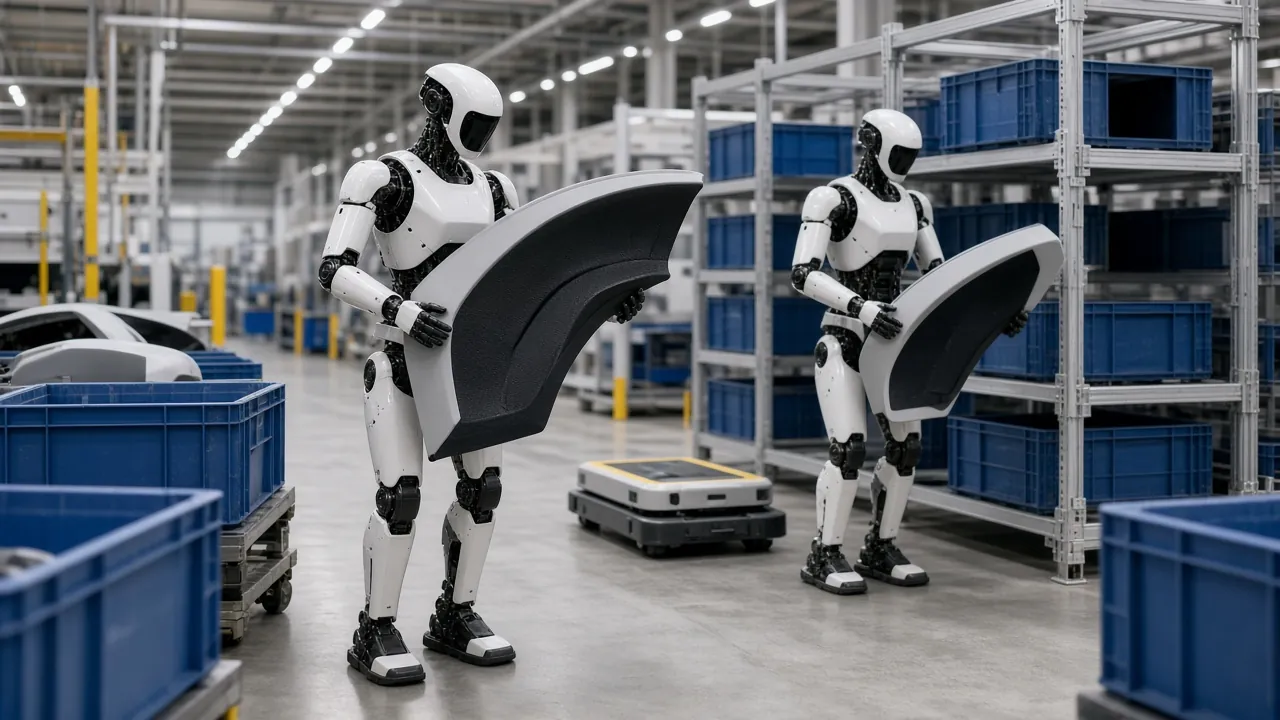
China's Cailian Press, as published by the 21st Century Business Herald, added details from the video and Xiaomi founder Lei Jun's post. The sped-up video runs 5 minutes 59 seconds, was filmed in the final assembly shop, and mainly features a robot called CyberOne 02. The task: take irregular, flexible trim panels out of bins, adjust their orientation, and place them into the correct rack slots in the order the assembly line needs them.
Two numbers answer the question Electrek raised about power. According to that report, the robots stopped to charge twice, after 3 hours 2 minutes and after 6 hours 3 minutes of cumulative work, and finished after 8 hours 5 minutes.
| Detail | Disclosed? | Source |
|---|---|---|
| Task and station | Yes | Xiaomi post; 21jingji |
| Total run time | Yes, 8 h 5 min | 21jingji |
| Charging breaks | Yes, two | 21jingji |
| Parts sorted, success rate | No | Electrek |
| Human interventions | No | Electrek |
The Dropped Part and the Wheeled Helper
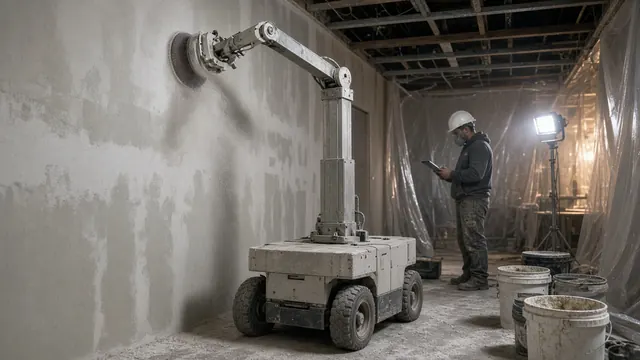
The most revealing moment is a failure. Partway through the second half, one of the legged robots dropped a part on the floor. A different robot, a humanoid upper body on a wheeled base, rolled over and picked it up. Electrek notes Xiaomi labels this segment "Dropped Material: Multi-Robot Collaboration," and that the parts bins themselves are moved by autonomous mobile robots.
Field note: Electrek's take is worth repeating: wheels beat legs on a flat factory floor. A wheeled base does not spend energy staying upright, carries a bigger battery and needs fewer actuators. The video quietly supports that argument.
What Was Left Out
Electrek's Fred Lambert put the gap clearly: "Xiaomi didn't say how many parts the robots sorted, what the success rate was over eight hours, or how many times a human had to step in." Without those numbers, "autonomous" is a claim, not a measurement.
Context helps. Electrek reports this is the third public milestone in Xiaomi's factory program: in March, a humanoid installed self-tapping nuts with a 90.2% success rate over three hours, fast enough for the station's 76-second cycle time; by July Xiaomi said that rate had reached 98%. That is more data than most humanoid makers publish.
When people questioned whether a humanoid belongs in a factory at all, Lei Jun replied, as quoted by Cailian Press: "This is a general-purpose humanoid robot. The hardware does not need to be changed; it can adapt to more different jobs and scenarios." (Our translation from Chinese.)
The Messy Middle: Why Sorting Trim Is Hard
Traditional industrial robots are superb at fixed, repeatable motions. This job is not one of those. The panels are large, flexible and irregular, and they sit in bins in random positions. Each must be picked, turned and slotted in sequence to match the cars coming down the line. Cailian Press describes it as a typical high-difficulty flexible-material task that tests whole-body motion, two-handed coordination, vision that ignores clutter, and force-sensitive handling. Doing that once is a demo. Doing it for a shift, at line speed, with error recovery, is the beginning of a job.
Decision Matrix: Reading the Next Humanoid Demo
- If a video has a speed multiplier: look for total run time and breaks, not just smooth motion.
- If it says "autonomous": look for a disclosed intervention count. No number means no verification.
- If it shows a mistake: good. Watch how it is recovered, and by whom.
- If a company publishes success rates and cycle times: give it more credit than one that only posts clips.
The Inflection Point
An eight-hour shift is a human unit of work. When a robot company frames its milestone that way, it is telling factory owners the robot can be scheduled like a worker. Xiaomi has not yet proven that with the numbers that matter most. But the shift itself, the charging breaks and the dropped part all point the same way: humanoids are leaving the stage and entering the timesheet. The next fair test is simple. Publish the intervention count.
Sources
We checked every fact, figure and quote in this story against the sources below. Quotes are reproduced as published. Images are AI-generated illustrations, not photos of the events described.
- Electrek: Xiaomi's humanoid robots work a full 8-hour shift in its EV factory (Nov 4, 2026)
- 21st Century Business Herald (21jingji) / Cailian Press: Xiaomi robots work 8 hours straight (Nov 4, 2026, Chinese)
- The Verge: Watch two humanoid robots put in a full 8-hour shift at a factory
- Xiaomi Tech on X (original video post, Nov 3, 2026)

RABTP Newsroom
Every story is researched against primary sources, then reviewed by publisher Sean Hakes before it goes live. We cover threats from the defender's side and never publish exploit details. Read our standards or send a correction.